What a steamer needs to do
Steaming cooks food with hot vapor rising from simmering water. In Japanese home cooking, it can be a gentle way to prepare vegetables, fish, dumplings and chawanmushi, a savory egg custard cooked in small cups. The equipment does not need to be specialized: it needs to hold food above the water, let steam circulate and keep enough heat inside for steady cooking.
Both bamboo baskets and metal steamers can do this well. The more useful question is how each will work with the pots you own and the foods you plan to make. Check the steamer’s diameter, the depth of the pot beneath it and the height available under the lid. A good fit matters more than the material: steam should reach the food without the insert sitting in boiling water, and the setup should feel stable when you lift the lid.
Where bamboo baskets shine
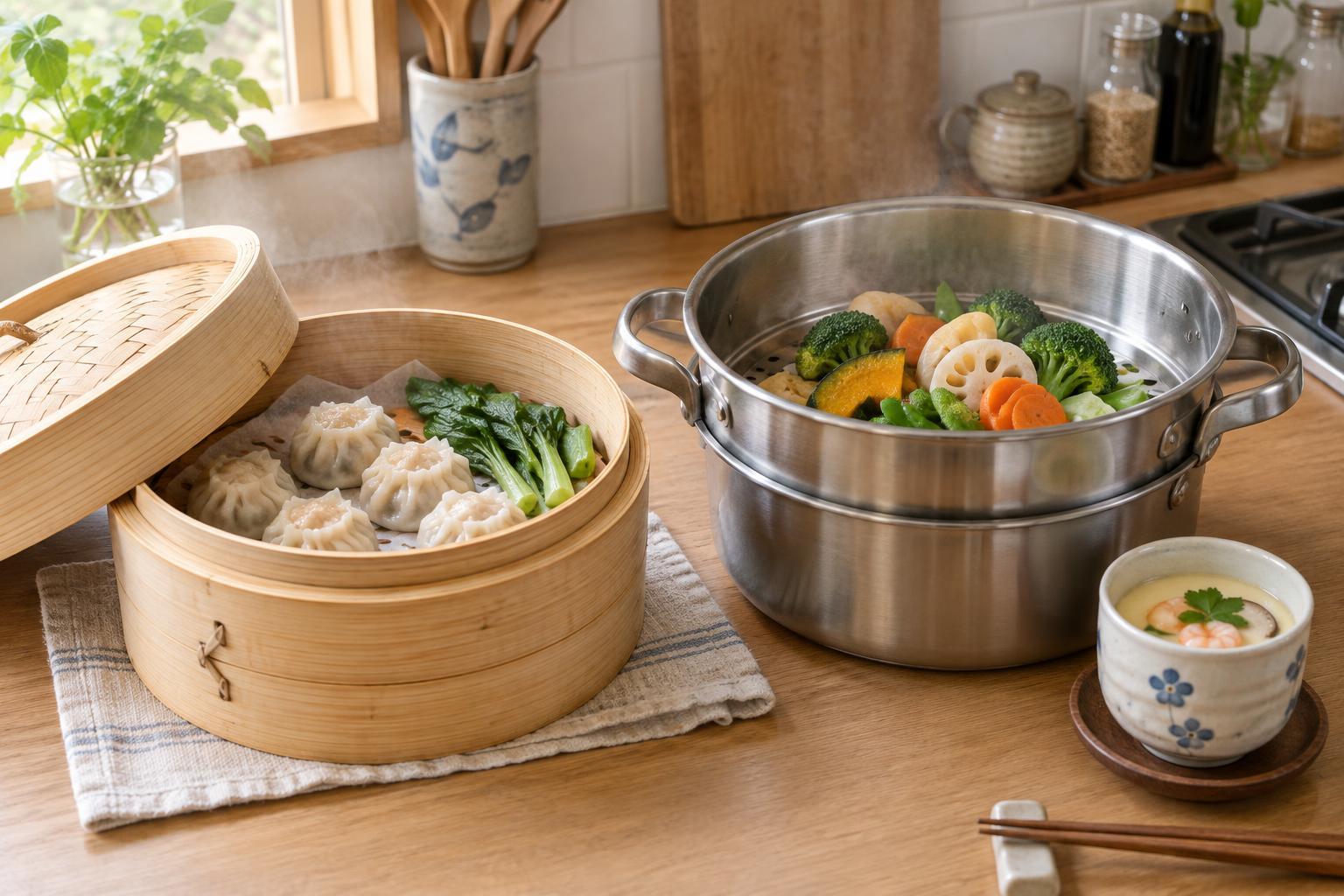
A bamboo steamer is a basket with a slatted base and a woven lid. Its familiar advantage is that the lid tends to absorb some moisture, which can reduce the droplets that fall back onto delicate food. This can be helpful for buns or dumplings, though the result still depends on how crowded the basket is and how vigorously the water boils. Bamboo baskets are often stackable, allowing you to cook more than one layer over the same pot.
Bamboo does require a suitable base. Some baskets sit over a wok or a pot fitted with a steamer ring; others can rest securely on a pot of the right diameter. The water must stay below the food. A perforated parchment round, cabbage leaves or another food-safe liner can help prevent sticking while leaving openings for steam. Avoid covering the entire slatted base with an unperforated sheet, which can slow circulation.
The trade-off is upkeep. Let bamboo cool, wash it according to the maker’s directions and dry it thoroughly before storing it. It should not remain damp in a closed cupboard. Bamboo can also retain food aromas more readily than metal, so a basket used for strongly seasoned fish may not be your first choice for a subtly flavored bun.
Why a metal steamer may be easier
Metal steamers come in several forms: a folding basket that opens inside a saucepan, a perforated insert made for a particular pot, or a tiered pot with its own lid. A metal insert is often the simplest choice if you already have a saucepan that fits it. It is sturdy, generally straightforward to clean and useful for everyday ingredients such as broccoli, sweet potatoes or fish set on a heatproof plate.
Unlike a bamboo lid, a metal lid does not absorb condensation. Droplets may fall onto the food, especially if the lid fits loosely or the water is boiling hard. For many vegetables this makes little difference. For chawanmushi, where a smooth surface is appealing, you can cover the individual cups loosely with foil or use their fitted lids if they are designed for steaming. Leave room for steam to move around the cups.
Check the insert’s usable space rather than its outside diameter alone. Folding baskets can be compact in storage but may not provide a broad, level surface for cups or plates. A fixed insert takes up more cupboard space, yet its flat base can make loading and unloading easier. If you use a metal insert, confirm that its handles remain accessible once the lid is on and use protection when lifting it.
Match the tool to the meal
Think about your most common task. For a few portions of vegetables, an insert that fits your everyday saucepan may be all you need. If you frequently steam dumplings or buns and want to cook them in layers, a bamboo basket can be convenient. If you plan to make chawanmushi, measure your cups and choose a setup with a stable, level base and enough height for the lid to close without touching them.
You can also use a heatproof plate inside either type of steamer for foods with a sauce or marinade. Make sure the plate leaves a gap around its edges so steam can rise. Arrange ingredients in a reasonably even layer rather than packing them tightly; crowded food can cook unevenly. When using stacked baskets, check the layers as needed, since their positions and the food they hold can affect cooking time.
Start with the setup you can use confidently
Before cooking, add enough water to the pot for the expected steaming time without letting it touch the food. Bring it to a simmer, set the steamer in place and keep an eye on the water level. Add hot water if needed, taking care around escaping steam. Open the lid away from your face and use oven mitts or a dry towel to handle hot parts.
There is no single best steamer for a Japanese-inspired home kitchen. Bamboo is appealing when stacking and a moisture-absorbing lid suit your cooking, provided you have space to dry and store it. Metal is a practical all-round choice when easy cleaning and compatibility with an existing pot matter most. Choose the one that fits securely, holds the foods you actually make and is simple enough to reach for on an ordinary day.