What a Japanese mandoline does well
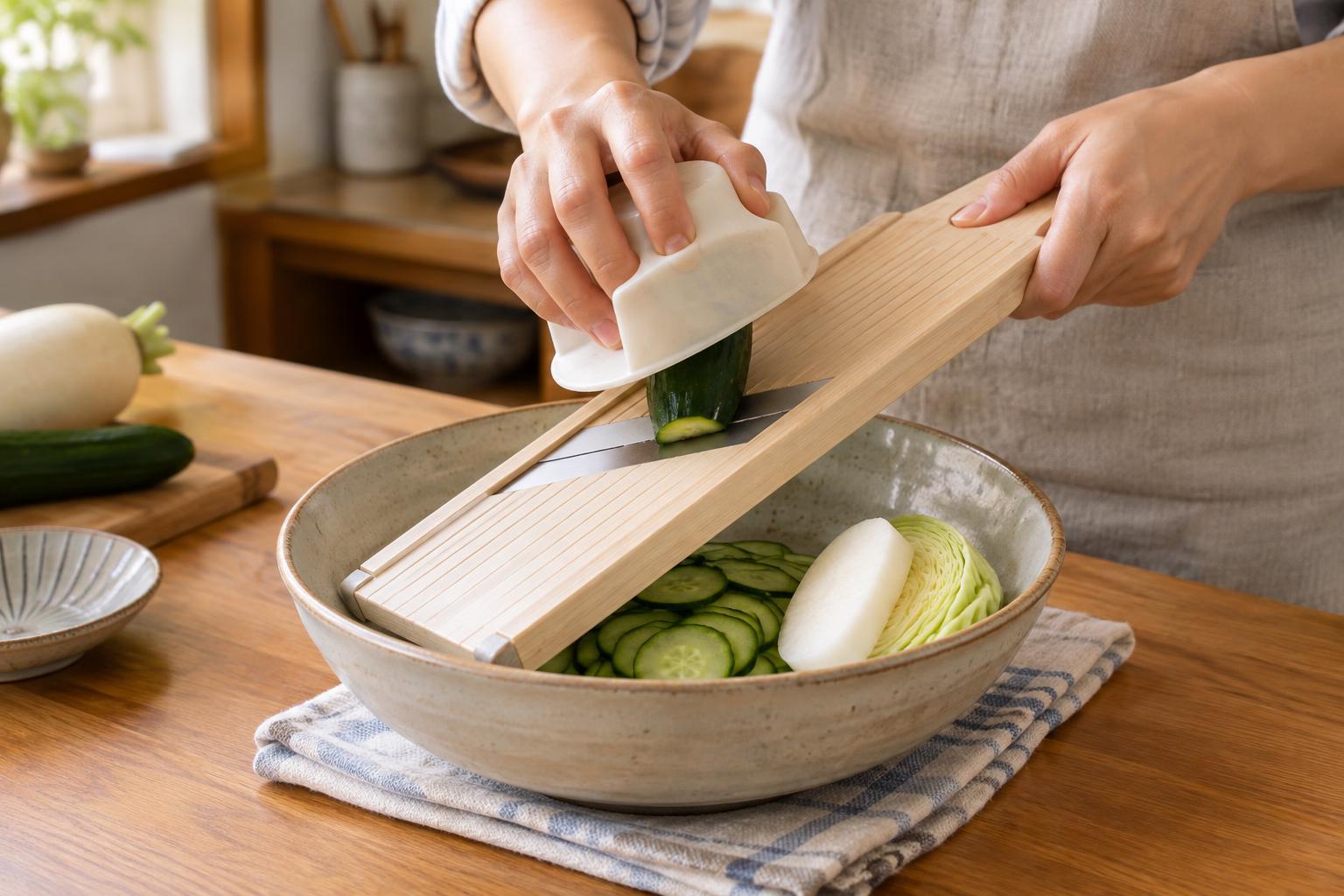
A Japanese mandoline is a compact slicer that passes vegetables over a fixed blade. Many models let you adjust slice thickness; some also accept blades for narrow strips. It is especially handy when you want consistent slices of cucumber for a quick pickle, fine daikon for a garnish, or thin cabbage for a salad. Unlike a knife, though, the blade stays in one place while your hand moves toward it. Treat every pass as a deliberate motion, even when the vegetable is still large.
Before you begin, check how your particular slicer adjusts and locks. Designs vary, and an attachment that looks secure may not be seated correctly. Start with a slightly thicker setting while you learn how much pressure the tool needs. Thin slices should come from a sharp blade and steady movement, not from forcing the vegetable downward.
Set up a stable slicing station
Place a wide bowl or container where the slices will fall, and keep the work area clear enough for your hands to move without bumping anything. If your mandoline rests on a counter, use it on a stable, nonslip surface. If it is designed to hook over a bowl, make sure the bowl cannot tip. Hold the slicer by its designated handle or support point, with your fingers away from the blade opening.
Prepare the ingredient before bringing it to the blade. Wash it, trim only what you need to, and cut an awkwardly shaped vegetable into a piece that sits securely in the hand guard. A flat side can help a round vegetable stay put. Do not make the piece so short that you must grip it close to the blade from the start. Keep your eyes on the slicer rather than looking away to check the growing pile of slices.
Let the guard protect your hand
Use the hand guard or food holder supplied with the mandoline whenever the ingredient fits it. Its job is to keep your fingers above the blade while holding the food steady. Check that the food is firmly caught before making smooth, controlled strokes. Avoid rapid back-and-forth slicing: speed can make it harder to notice when the vegetable becomes too small.
A cut-resistant glove can add protection, particularly when a food holder is difficult to use, but it is not cut-proof and should not be treated as permission to touch the blade. Choose a glove intended for food preparation, keep it clean, and follow its care instructions. The simplest safety rule remains the same with or without a glove: keep fingers clear of the cutting edge.
Know when to stop
The last bit of a carrot or cucumber is not worth chasing across an exposed blade. Stop when the guard no longer holds the piece securely or when you cannot complete a stroke without bringing your hand close to the edge. Set the remnant aside for knife work, a soup or another dish. If an ingredient slips, pause and reset it rather than trying to catch it mid-stroke.
Match the ingredient to the tool, too. Very soft, slippery or irregular pieces may be easier to cut with a knife. For long vegetables, work with a manageable length rather than balancing the whole piece over the slicer. Consistent slices are useful, but control matters more than making every piece identical.
Clean and store the blade with care
Clean the mandoline soon after use so vegetable fibers do not dry around the blade. Follow the maker’s cleaning directions, especially for removable blades. Do not wipe along the cutting edge with a sponge or reach under it with your fingers. A brush can help dislodge trapped pieces while keeping hands farther away; move it in a direction that does not drag it across the sharp edge. Let the slicer dry fully before storage.
Replace any blade cover and store loose attachments where they will not be encountered by accident in a drawer. A mandoline earns its place in a home kitchen by making repeatable slices for everyday dishes. A stable setup, a properly used guard and a willingness to leave the final stub unsliced make it a much more comfortable tool to reach for.