Why make dashi ahead?
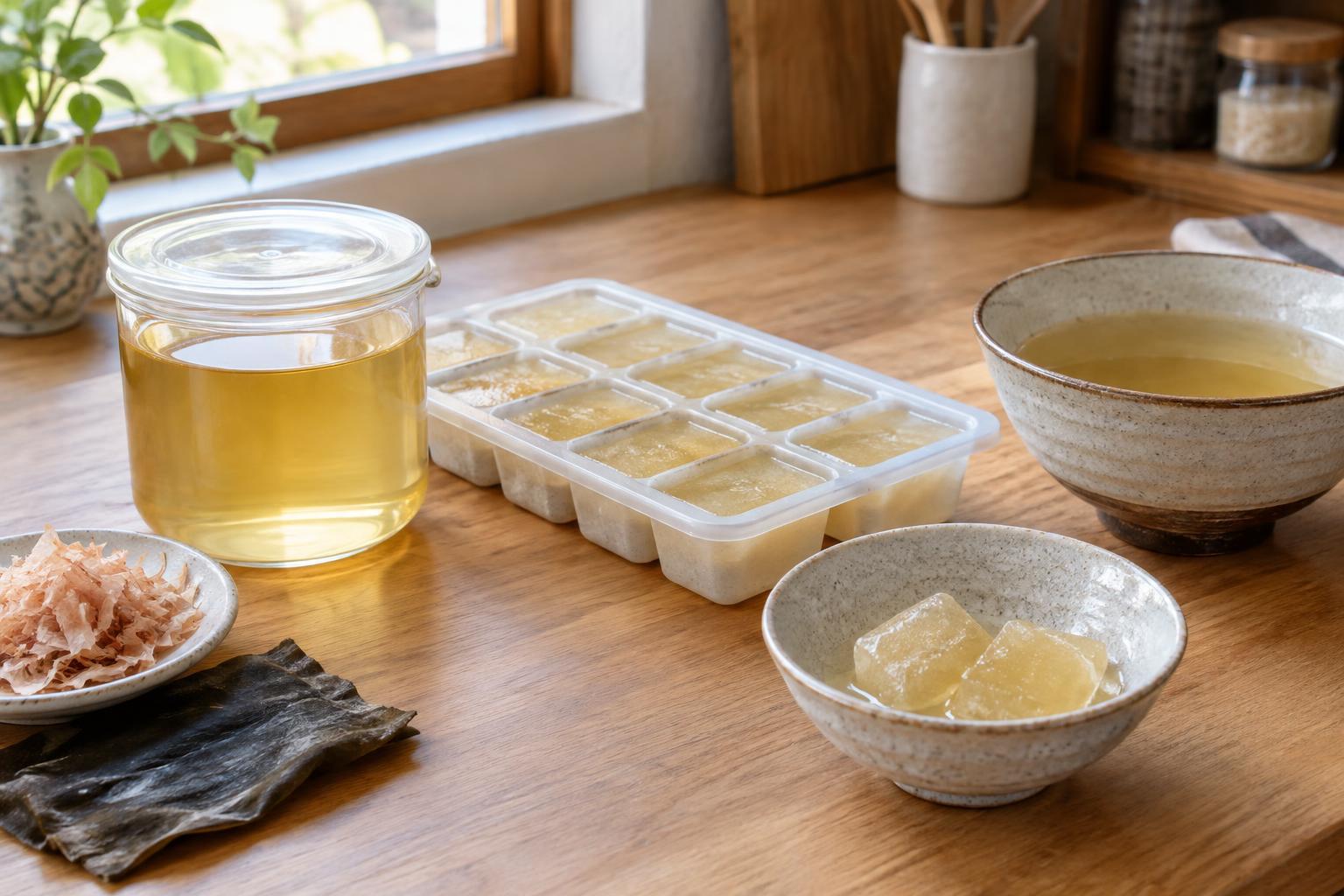
Dashi is the savory cooking liquid that forms the base of many Japanese home dishes. A pot of kombu and bonito dashi can become miso soup one day and the cooking liquid for vegetables the next. Kombu dashi, made with kelp alone, and shiitake dashi, made with dried mushrooms, are useful alternatives. Keeping some ready to use can make a small meal feel much easier to put together.
For the best flavor, make only what you expect to use soon and freeze any extra. Dashi is usually an ingredient rather than a finished soup: you can season it when you cook, according to the dish. Labeling a container with the type of dashi and the day you made it helps you reach for the right one later.
Cool and refrigerate it promptly
Strain freshly made dashi to remove the kombu, bonito flakes, or mushrooms. If you plan to use the solids in another dish, set them aside separately. Pour the liquid into clean, shallow containers or divide a large batch among smaller ones so it cools more readily. Avoid leaving a warm pot on the counter for an extended period; once the dashi has stopped steaming heavily, cover it and move it to the refrigerator.
Refrigerated dashi is best treated as a short-term ingredient. Plan to use it within a few days, and freeze it instead if your plans change. Keep containers closed so the liquid does not pick up refrigerator odors. Before cooking, check that it smells as expected; discard dashi that smells sour or otherwise off, or that has visible signs of spoilage. A change in appearance alone is not always a problem—fine particles can settle—but it is no substitute for careful storage.
Freeze portions that match the way you cook
Freezing is especially handy when a recipe leaves you with more dashi than you need. For soup or simmered dishes, freeze it in measured containers large enough for a pot. For a splash of liquid to loosen a sauce or cook a small serving of greens, use a clean ice cube tray. Once the cubes are solid, transfer them to a sealed freezer bag or container and label it. Remove as much air as practical to help protect the flavor.
Leave room for expansion in rigid containers, and use containers intended for freezing. Write down the portion size as well as the type and date: cubes of kombu dashi and cubes of stronger kombu-bonito dashi may look much the same. Frozen dashi can gradually lose its fresh aroma, so use older portions first rather than treating the freezer as indefinite storage. If your dish depends on a delicate dashi flavor, consider making a fresh batch.
Thaw only what you need
For the most flexible option, put a frozen container in the refrigerator and let it thaw there. Keep it covered and use the thawed dashi promptly. Small cubes can often go straight into a simmering pan, where they will melt as the dish heats. A larger frozen portion can also be warmed directly in a saucepan over gentle heat, with occasional stirring so it melts evenly.
Avoid thawing dashi on the counter. If you need to thaw it quickly, use a microwave-safe container and the microwave’s defrost setting, then heat or cook with the dashi right away. Bring dashi used in a hot dish up to the temperature needed for that dish rather than merely warming the outside of a still-frozen block. It is simplest to thaw a portion once and use it, not repeatedly thaw and refreeze the same batch.
Build a small dashi routine
A useful routine does not require a large stockpot. Make a batch when you already have time at the stove, refrigerate enough for an upcoming meal, and freeze the rest in portions you know you will use. If you make different kinds, label them clearly. Kombu dashi offers a gentle base for vegetables, while kombu-bonito dashi brings a more pronounced savory flavor to many soups and simmered dishes.
When it is time to cook, taste the dashi before adding soy sauce, miso, or salt. Freezing and reheating may soften its aroma, but it can still provide a satisfying foundation. Having a few well-labeled portions on hand lets you start with the liquid your dish needs—without having to make a new batch every time.