What makes a saucepan a yukihira?
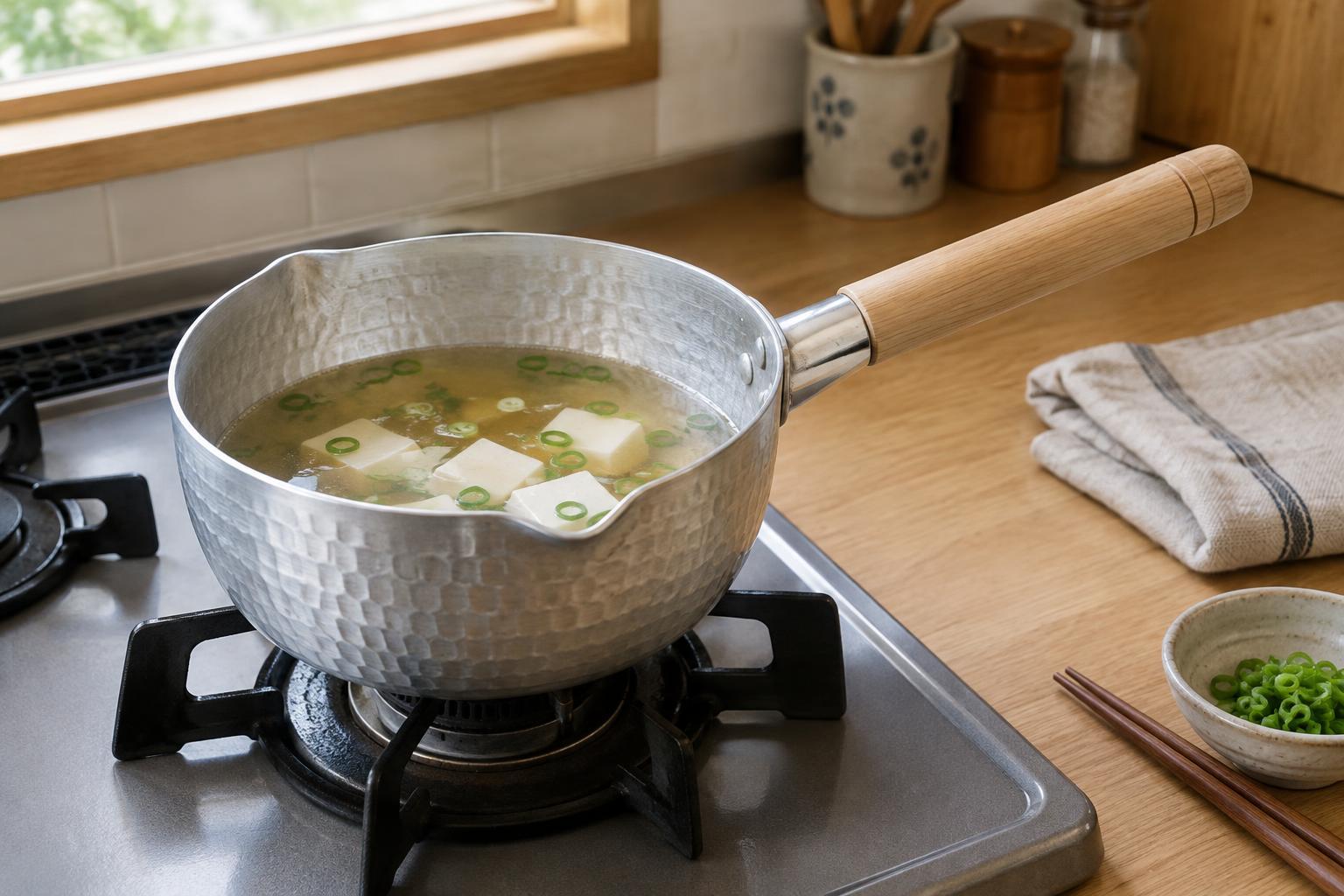
A yukihira is a small, single-handled saucepan commonly used for everyday cooking in Japan. Traditional versions are made from lightweight aluminum and have a dimpled surface. Many have a pouring lip on both sides, making it easy to tip liquid into a bowl whether you hold the handle with your left or right hand. The sides are usually higher than those of a frying pan, but the pot remains light enough to lift and pour with one hand.
The dimples are a familiar feature, not a requirement for every pan sold under the name. Yukihira-style saucepans also come in stainless steel and other constructions. Depending on the model, the handle may be wood, metal, or another heat-resistant material. Check the particular pan rather than assuming that its material, lid, or stovetop compatibility matches a traditional aluminum version.
Where it fits into everyday cooking
Think of a yukihira as a working saucepan for modest amounts of liquid. It is useful for warming dashi, making miso soup, simmering vegetables, preparing a small portion of noodles, or heating a sauce. The pouring lips are especially handy when you want to transfer broth or sauce without reaching for a ladle. Its light weight also makes it convenient when a dish needs to be moved on and off the heat frequently.
For a simple meal, you might simmer sliced vegetables in dashi, add seasoning, and pour the finished broth straight into serving bowls. You can also use the pan to blanch greens or warm milk, provided you watch it closely and stir as needed. A yukihira does not replace every pot: a larger stockpot is better for generous batches, and a wide frying pan gives food more room to brown. Because a yukihira is relatively narrow and has a handle extending from one side, take care that it sits securely on the burner, especially when nearly empty.
Choosing a useful size and material
Yukihira pans are commonly labeled by their diameter in centimeters, measured across the top. A 16-centimeter pan suits small portions, sauces, and quick reheating. An 18-centimeter pan is a flexible starting point for one or two people, while a 20-centimeter pan provides more space for soup or simmered ingredients. These are guides, not fixed serving sizes: usable capacity varies with the pan’s depth, and liquids need room to bubble without spilling. If possible, consider the amount you usually cook and the size of your stovetop burners.
Aluminum heats quickly and is easy to lift, though it is generally unsuitable for induction unless the pan has a compatible base. Stainless steel is often more resistant to staining and may suit cooks who prefer not to use bare aluminum, but induction compatibility still depends on the pan’s construction. Check the maker’s guidance for your stovetop. Also look at the handle: it should feel secure and comfortable when you lift the pan with food in it. A lid can be helpful for simmering, but many yukihira pans are sold without one, so check whether a matching lid is available if you want it.
Using your pan comfortably and safely
Start with moderate heat and adjust as the contents warm. A lightweight pan can heat quickly, and food may catch if a thick sauce is left unstirred. Keep the handle turned away from the edge of the stove, and use a cloth or mitt if it becomes hot. When pouring, hold the pan steadily and give hot liquid a clear path into the receiving bowl. If you use a gas stove, keep the flame beneath the base rather than letting it climb the sides or reach the handle.
Bare aluminum can react with acidic or very salty foods, particularly during long cooking or storage. For a brief sauce this may be less of a concern, but choose another vessel when you plan to simmer a strongly acidic dish for a long time or refrigerate leftovers in the pot. Follow any care instructions supplied with your pan, as coatings and mixed-material designs may call for different utensils or heat settings.
Cleaning and storing a yukihira
Let the saucepan cool before washing it; a sudden temperature change can be hard on cookware. For routine cleaning, use warm water, mild dish soap, and a soft sponge. If food has stuck, soak the pan briefly and loosen the residue gently rather than scraping the surface with a sharp tool. Bare aluminum can darken or discolor with use, which does not necessarily mean the pan is dirty. Avoid abrasive polishing unless the maker recommends it.
Dry the pan thoroughly, including the area where the handle meets the body, before putting it away. Do not assume it is dishwasher-safe, particularly if it has a wooden handle or an aluminum surface; check the manufacturer’s directions. Stored where its pouring lips will not be knocked, a yukihira is easy to reach for the small, frequent cooking jobs that make it so useful.